I started with Gemini. Paggered began when the chat wasn't enough.
Jack 'TheMiTRENnial' Mosley
EngineeringFitness
I didn’t set out to build a fitness app. I wanted to look like Jack Reacher. No, really. Alan Ritchson was the goal.
Not the bit where he survives a train crash with a stern look and a clean shirt. The useful bit: prepared, imposing and the one you ask to help you move furniture.
I started using Gemini 3 Pro because I wanted help getting there. Structured workouts. Nutrition that made sense. Something that understood my injuries, in lieu of NHS waiting lists, and my goals instead of handing me a generic plan and telling me to crack on.
And, annoyingly, it was good. Good enough that I stopped asking whether AI was a gimmick and started asking a more inconvenient question: what happens when the context needs compacting?
The bit that worked
Gemini could take a messy explanation and turn it into something usable. It could help shape a training week, talk through food, and account for the fact that bodies are not spreadsheets and injuries are real. Having it account for my gammy shoulder was quite impressive when it was structuring workouts with alternatives and an overarching ‘Yeah don’t do this’ tone.
The bit that broke
Every chat had an expiry date, especially the big useful one. The reasoning lived in one thread. The workout got recorded somewhere else. The next conversation started with me rebuilding the context from scratch, like a mad AI librarian.
That is where a good chat stops being enough. The model can help me think, but it cannot keep doing that job if I have to carry the entire past back into the room every time.
The question became a product
If the advice depends on training history, recovery, nutrition, injuries and goals, those things need to be part of the system. Not a paragraph I paste into a prompt every day of the week. Not a memory I hope the chat has retained. A record.
That was the beginning of Paggered. Not a grand startup thesis. A practical irritation that refused to go away.
The first useful loop
The early work became less about adding every feature a fitness platform might eventually need (that didn’t last long) and more about making one loop worth returning to:
- Record what actually happened in the session.
- Bring the relevant training, recovery and nutrition context alongside it.
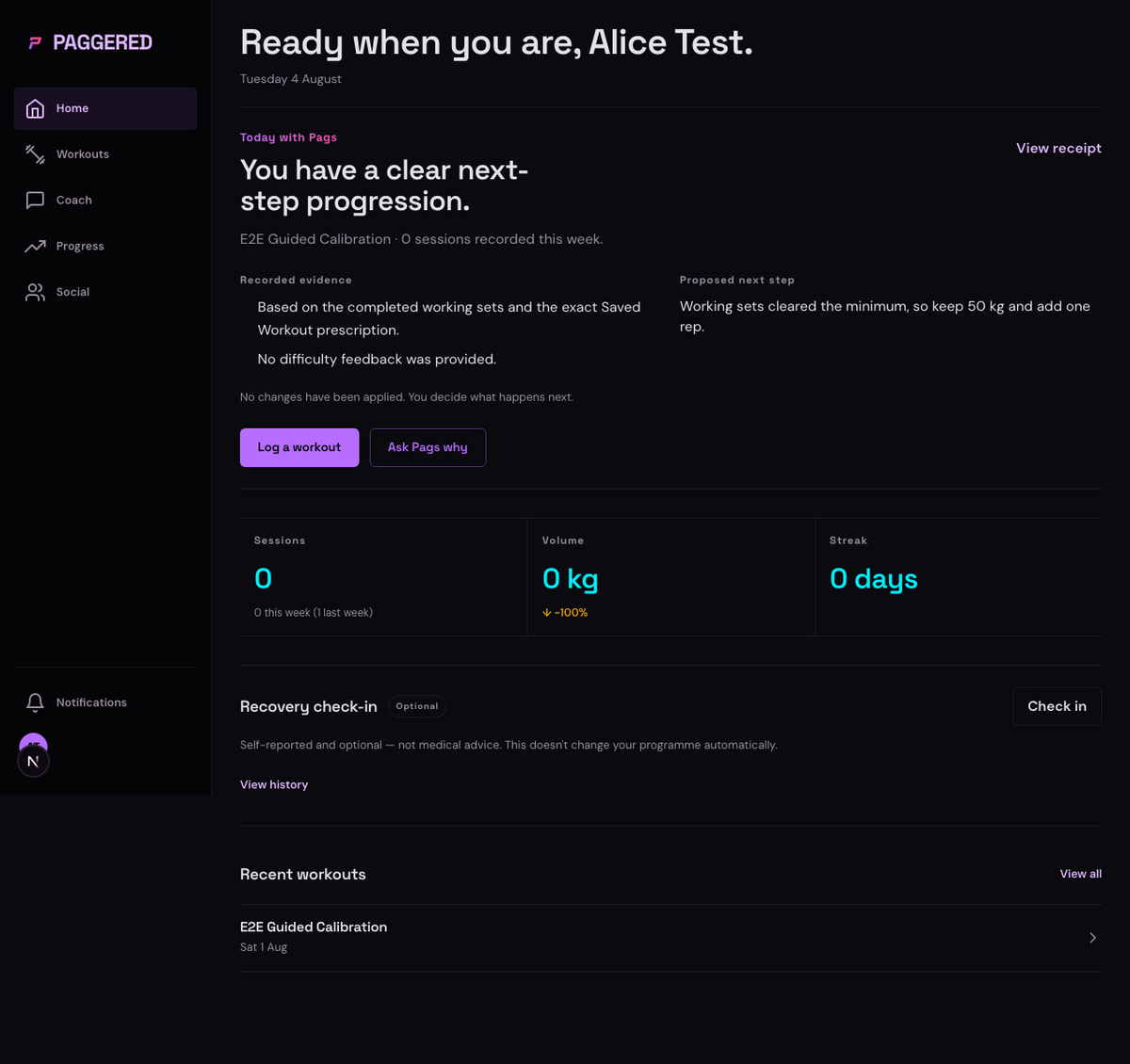
- Ask Pags for a next step grounded in that record.
- Show the reasoning and leave the decision with the athlete.
That is why Paggered grew beyond a chat endpoint. The workout tracker is the backbone — the thing I use as an everyday tool. The AI agent is the standout, because that is where the raw log turns into a useful next step. Both need each other. A clever answer on top of a rubbish record is just another shiny demo.
Make the advice leave a receipt
The advice needed a receipt. What did Pags suggest? What did it base that on? What happens if I disagree?
The system can suggest a next step, but it does not get to quietly rewrite someone’s training and call that intelligence. If it affects my body, I want to see the working — not be handed a mystical answer in a purple bubble.
That receipt is the line I keep coming back to. If software is going to help me train, it needs to show its working. Otherwise it is just a confident voice with a memory problem.
What I was actually building
I wasn’t trying to build a clever chatbot. I was trying to make the useful bit of that Gemini experience stick around after the chat window closed. I had a target, a few constraints, and a model that had shown me the conversation could be useful. Paggered grew out of wanting that usefulness to survive past a single thread.
The name and the surface have changed. The question is still sat there: can software help me think more clearly about my own training because it remembers what I actually did?
The beginning, not the conclusion
That is still the answer I am working on. Start with the evidence. Show the working. Leave the decision with the person doing the work. Simple enough to say. Harder to build.
Everything else can wait. The loop has to earn its place.